
Download
Website Accessibility Standards in the UK
An overview of WCAG 2.1 and WCAG 2.2, UK accessibility responsibilities and practical guidance for private businesses and public-sector organisations.
Website accessibility means ensuring that people can use a website regardless of disabilities affecting sight, hearing, movement, speech, cognition or learning.
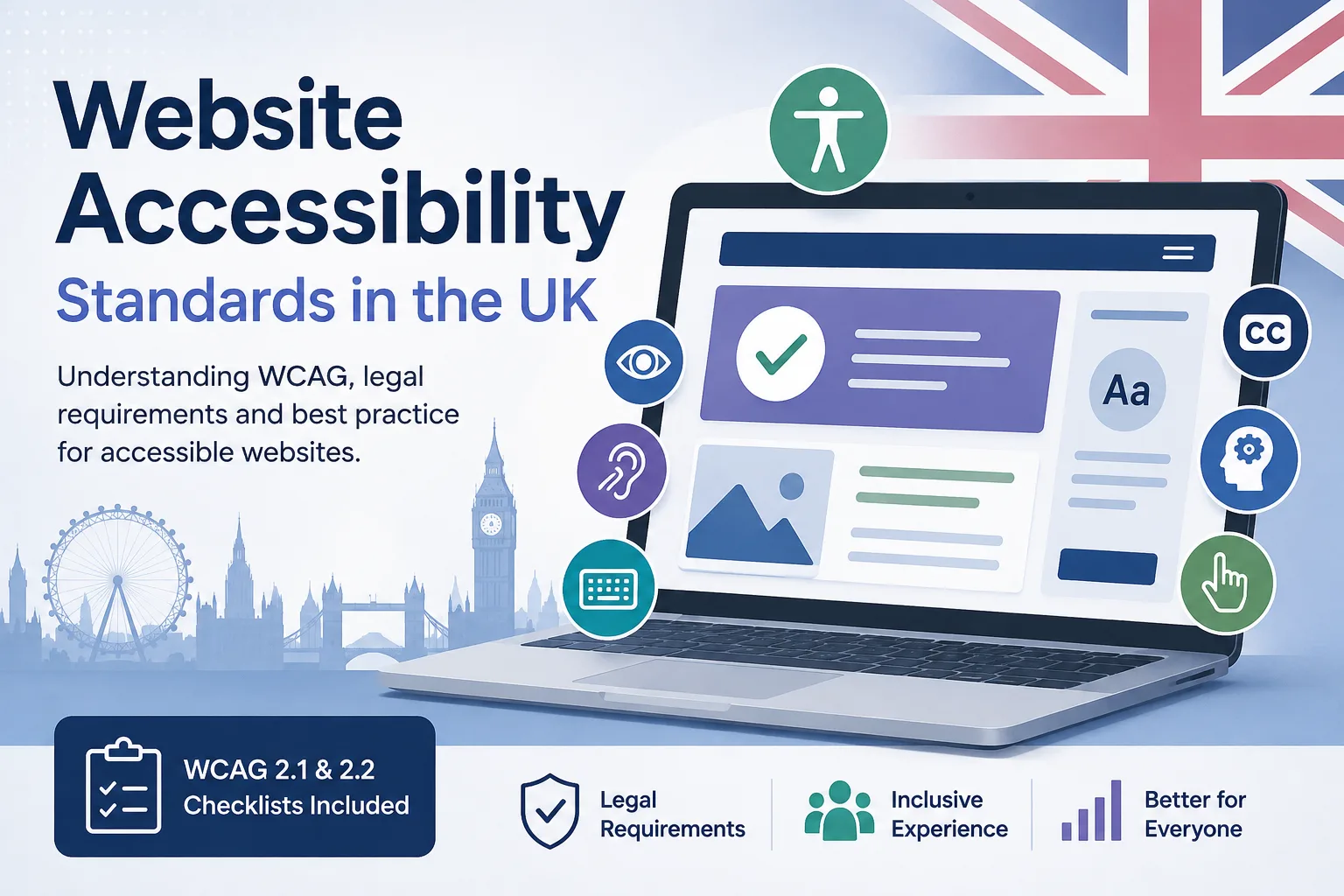
Accessibility applies to more than the visual design of a website. It includes the underlying code, written content, navigation, forms, documents, video, audio and interactive features.
The main technical standard used for website accessibility is the Web Content Accessibility Guidelines, commonly known as WCAG.
WCAG is organised around four principles:
• Perceivable: users must be able to perceive the information presented
• Operable: users must be able to navigate and operate the website
• Understandable: content and controls must be clear and understandable
• Robust: the website must work reliably with browsers and assistive technologies
WCAG has three conformance levels:
• Level A
• Level AA
• Level AAA
Most organisations aim for Level AA, which requires the website to meet all applicable Level A and Level AA success criteria.
Which accessibility standard applies in the UK?
The accessibility requirements that apply depend on the type of organisation and the service being provided.
| Organisation or website | UK position | Recommended target |
|---|---|---|
| General private-sector businesses | The Equality Act 2010 requires service providers to avoid disability discrimination and make reasonable adjustments. It does not specify one WCAG version that every private website must meet. | WCAG 2.2 AA |
| Retail and e-commerce businesses | Online services should not place disabled customers at a substantial disadvantage. This includes browsing, account creation, checkout and payment processes. | WCAG 2.2 AA |
| Employers and recruitment websites | Employers may need to make reasonable adjustments for disabled applicants and employees. This can apply to recruitment portals, online application forms, intranets and employee systems. | WCAG 2.2 AA |
| UK government departments | Covered by the Public Sector Bodies Accessibility Regulations and the Equality Act. Websites and mobile apps are generally expected to meet WCAG 2.2 AA and publish an accessibility statement. | WCAG 2.2 AA required, subject to limited exemptions |
| Councils, NHS organisations and other public authorities | Generally covered by the public-sector accessibility regulations. | WCAG 2.2 AA required |
| Universities and public-sector education bodies | Generally covered where they meet the definition of a public-sector body, although some content may be exempt. | WCAG 2.2 AA required |
| Charities | A charity is not automatically covered by the public-sector regulations simply because it is a charity. It may still have duties under the Equality Act and could be covered if it qualifies as a public-sector body. | WCAG 2.2 AA |
| Broadcasters and media companies | Their websites are subject to general Equality Act duties. Broadcast and on-demand services may also have separate Ofcom accessibility requirements. | WCAG 2.2 AA for websites, plus applicable Ofcom requirements |
| Newspapers, magazines and digital publishers | There is not normally a separate WCAG standard solely because an organisation is a publisher. Equality Act duties still apply to its digital services. | WCAG 2.2 AA |
| Businesses supplying government | A private supplier may be contractually required to meet public-sector accessibility standards when delivering a website or digital platform for a public authority. | Usually WCAG 2.2 AA, depending on the contract |
Accessibility requirements for private UK businesses
Most private companies in the UK are not covered by the Public Sector Bodies Accessibility Regulations.
However, they are still subject to the Equality Act 2010.
The Equality Act requires service providers to avoid discriminating against disabled people and to make reasonable adjustments where a disabled person would otherwise be placed at a substantial disadvantage.
This duty is anticipatory. Businesses should consider the needs of disabled users in advance rather than waiting for someone to complain.
For a business website, accessibility considerations commonly include:
• Contact and enquiry forms
• Quotation request forms
• Online shops and checkout processes
• Account registration and login
• Appointment booking
• Job applications
• Customer portals
• Downloadable PDFs
• Video and audio
• Cookie banners
• Live chat
• Third-party tools and widgets
The Equality Act does not state that every private business website must meet a particular version of WCAG. However, using WCAG provides a recognised and measurable way to demonstrate that accessibility has been considered.
For new websites, WCAG 2.2 AA is the recommended target.
Is WCAG 2.1 still valid?
Yes.
WCAG 2.2 was published by the World Wide Web Consortium on 5 October 2023. However, WCAG 2.1 was not withdrawn, invalidated or formally superseded.
WCAG 2.1 remains a published and recognised accessibility standard.
This is important because a website that meets WCAG 2.1 AA has still completed a substantial amount of meaningful accessibility work. It should not be treated as inaccessible simply because it has not yet been assessed against WCAG 2.2.
WCAG 2.2 builds upon WCAG 2.1 rather than replacing the entire standard. Most WCAG 2.1 requirements remain part of WCAG 2.2.
WCAG 2.2 adds further requirements covering areas such as:
• Keyboard focus being hidden behind sticky content
• Clearer visible keyboard focus
• Alternatives to dragging movements
• Minimum clickable target sizes
• Consistent placement of help
• Avoiding unnecessary repeated data entry
• More accessible authentication processes
It also removes the older 4.1.1 Parsing success criterion.
Can private companies still work towards WCAG 2.1 AA?
Yes.
A private company can still use WCAG 2.1 AA as a meaningful stepping stone towards improving the accessibility of its website.
This may be particularly reasonable where:
• An existing website was originally built against WCAG 2.1
• An accessibility audit has already started using WCAG 2.1
• A contract or specification refers to WCAG 2.1
• Budget or time constraints mean improvements need to be introduced in phases
• The organisation is beginning its first structured accessibility programme
Working towards WCAG 2.1 AA demonstrates that the company is taking accessibility seriously and is using a recognised technical standard.
It is significantly better than having no accessibility target, no testing process and no improvement plan.
However, companies should not treat WCAG 2.1 AA as the final destination for a new or actively maintained website.
The recommended approach is to complete the WCAG 2.1 improvements, review the additional WCAG 2.2 Level A and AA criteria and create a plan for addressing any remaining gaps.
A company could accurately state:
“Our website has been designed and tested against WCAG 2.1 Level AA. We are continuing to improve its accessibility and are working towards WCAG 2.2 Level AA.”
It would be less accurate to state that a WCAG 2.1 AA website meets the latest accessibility standard, as WCAG 2.2 is now the latest version within the WCAG 2 series.
Meeting WCAG 2.1 AA should therefore be viewed as genuine accessibility progress and a strong foundation, but organisations should continue improving their website and aim to reach WCAG 2.2 AA.
Government and public-sector websites
UK public-sector websites and mobile applications must normally:
1. Meet WCAG 2.2 Level AA
2. Publish an accessibility statement
3. Identify known accessibility problems
4. Explain how users can request information in an accessible format
5. Provide a way to report accessibility problems
6. Review and update the accessibility statement when the service changes
There are some exemptions and public bodies may sometimes rely on a disproportionate burden assessment.
However, this is not a general permission to ignore accessibility. Any disproportionate burden decision should be properly assessed, documented and explained in the organisation’s accessibility statement.
For public-sector organisations, WCAG 2.1 AA is no longer the appropriate target for a new website or current accessibility assessment. WCAG 2.2 AA should be used.
Media, broadcasters and on-demand services
Media organisations must consider both website accessibility and the accessibility of the content they publish.
A media company’s website should generally be treated in the same way as another private digital service under the Equality Act. WCAG 2.2 AA should be used as the recommended technical benchmark.
Broadcast and on-demand content may also be subject to separate Ofcom requirements relating to:
• Subtitles
• Audio description
• Signing
• Information about accessible programmes
• The quality and availability of access services
• Reporting requirements
These obligations are related to website accessibility but are not the same thing.
A broadcaster may therefore need to consider both:
• Whether its website and digital platforms are accessible
• Whether the television, video or on-demand content it provides meets the relevant Ofcom requirements
WCAG conformance does not guarantee legal compliance
Meeting WCAG is strong evidence that an organisation has taken accessibility seriously.
However, WCAG conformance does not automatically guarantee compliance with the Equality Act.
Legal compliance may also depend on:
• The nature of the service
• The needs of individual users
• Whether disabled users experience a substantial disadvantage
• Whether reasonable adjustments have been offered
• How accessibility issues are handled when they are reported
• Whether inaccessible third-party services are used
Similarly, a website that has not yet achieved full WCAG AA conformance is not necessarily making no accessibility effort.
An organisation may be working through a documented improvement programme, prioritising the most serious barriers and making reasonable adjustments while further technical work is completed.
Recommended approach for private businesses
For an existing website currently being assessed against WCAG 2.1 AA, a sensible approach is to:
1. Complete the identified WCAG 2.1 AA improvements
2. Test the additional WCAG 2.2 Level A and AA requirements
3. Record any outstanding accessibility issues
4. Prioritise issues based on their impact on users
5. Publish an accessibility statement or accessibility information page
6. Provide a way for users to report accessibility problems
7. Create a realistic plan for reaching WCAG 2.2 AA
8. Re-test the website after significant design, content or development changes
For a completely new website, WCAG 2.2 AA should be included in the design and development specification from the start.
Building accessibility into a website from the beginning is usually more efficient and less expensive than attempting to retrofit it later.
Summary
WCAG 2.1 AA remains a valid and recognised accessibility standard. It was not formally withdrawn or completely replaced when WCAG 2.2 was published.
Private UK companies can still use WCAG 2.1 AA as a practical stepping stone towards improving website accessibility, particularly when upgrading an existing website or working through accessibility improvements in phases.
However, WCAG 2.2 AA is now the recommended standard for new website projects and ongoing accessibility programmes.
A private company meeting or working towards WCAG 2.1 AA can demonstrate genuine accessibility progress, but it should continue reviewing and improving the website with the aim of reaching WCAG 2.2 AA.